 HERMES SOCRATICUS
Quantum & computing
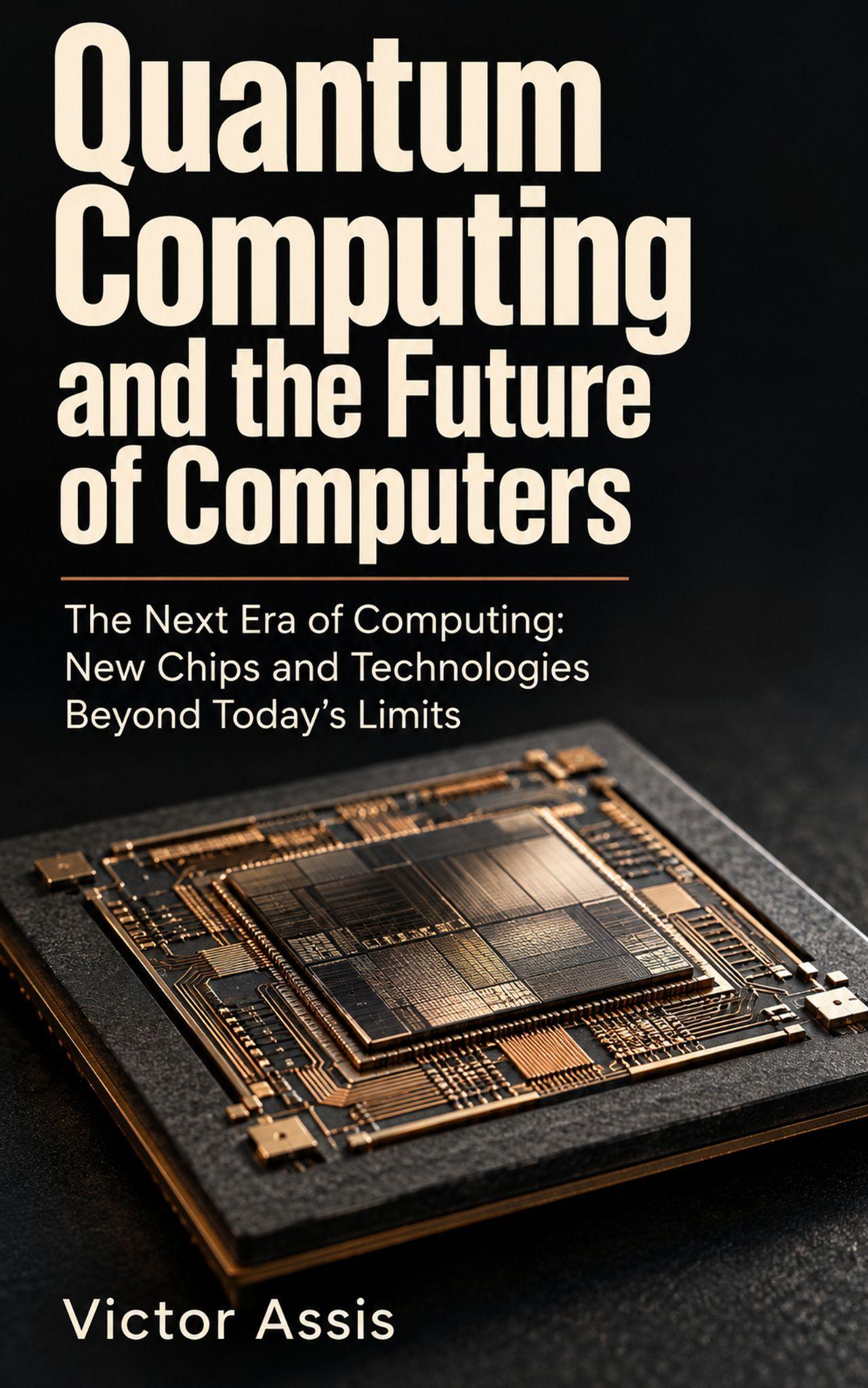
Quantum Computing and the Future of Computers
The Next Era of Computing: New Chips and Technologies Beyond Today's Limits
How will computers keep advancing when making smaller chips is no longer enough? Quantum computing offers one possible path-but the future of processing also involves artificial intelligence, photonic computing, and new semiconductor architectures.
The argument
Quantum Computing and the Future of Computers explores the foundations of classical computing and the physical, energy, and economic constraints reshaping the industry. Transistors, Moore's Law, GPUs, and specialized accelerators provide the groundwork for understanding why the next era of computing requires more than faster processors.
The book explains qubits, superposition, entanglement, and quantum algorithms while examining the challenges of error correction and fault-tolerant quantum computers. It investigates potential applications in drug discovery, materials research, optimization, and machine learning, alongside the implications for digital security and the importance of post-quantum cryptography.
Beyond quantum computing, the discussion covers neuromorphic chips, processing with light, reversible computing, chiplets, and three-dimensional stacking. Manufacturing costs, industrial concentration, and competition for technological sovereignty reveal how these developments affect businesses, governments, and digital infrastructure.
Written for students, professionals, and readers interested in technology, this book offers a broad understanding of emerging computing systems and their practical limitations. It examines which problems different architectures can address, where significant obstacles remain, and why the future of computers will depend on integrating multiple technologies.
Read around the book
Continue the investigation.
Quantum Computing in 2026: What Separates Experimental Machines from Practical Quantum Computers?
Quantum computing entered 2026 with an important change in emphasis. For years, progress was often described in terms of how many qubits a processor contained or whether a machine could outperform a classical computer on a carefully chosen laboratory task.
Quantum Computing vs Classical Computing: What Are the Real Differences?
Classical and quantum computers are built to process information in fundamentally different ways. A classical computer uses bits that represent one of two states, usually written as 0 or 1. A quantum computer uses qubits, which follow the rules of quantum physics and can behave in ways that ordinary bits cannot.
Will Quantum Computers Break Bitcoin and Modern Encryption?
Quantum computers could eventually threaten some of the cryptographic systems that protect Bitcoin, financial transactions, digital signatures, secure websites, and government infrastructure, but that does not mean those systems are currently vulnerable to quantum attacks.
Post-Quantum Cryptography: How Will the Internet Stay Secure?
Post-quantum cryptography is designed to protect digital systems against attacks from future quantum computers without requiring users to own quantum hardware themselves. The goal is to replace vulnerable public-key algorithms with new mathematical techniques that can run on ordinary computers but are believed to resist both classical and quantum attacks.
Quantum Computing and AI: Can Quantum Computers Accelerate Artificial Intelligence?
Quantum computing and artificial intelligence are often presented as two technologies that could reinforce each other, especially as AI models demand more computing power and quantum processors continue to improve.
Quantum Error Correction: The Biggest Challenge in Quantum Computing
Quantum error correction is one of the most important problems in the development of practical quantum computers. Quantum processors can already perform sophisticated experiments, but their qubits are extremely fragile.
Beyond Nvidia GPUs: How AI Chips Are Changing the Future of Computing
The rapid expansion of artificial intelligence is changing the way computers are designed. For years, GPUs became the dominant hardware for training and running large AI models because their highly parallel architecture is well suited to the matrix calculations used in neural networks.
Is Moore's Law Dead? Why Computer Chips Are Reaching Their Limits
For decades, the progress of computing was closely associated with a simple trend: semiconductor manufacturers kept placing more transistors on each generation of computer chips. Smaller transistors made it possible to build processors that were faster, more capable, and often cheaper per unit of computation.
Photonic Computing: Can Light Replace Electricity in Future AI Chips?
Photonic computing uses light rather than electrical current to transmit information and, in some designs, to perform calculations. The idea is especially attractive for artificial intelligence because modern AI systems move and process enormous amounts of data, and that movement consumes substantial energy.
Neuromorphic Computing: How Brain-Inspired Chips Could Transform AI
Neuromorphic computing is an approach to processor design inspired by the way biological nervous systems handle information. Instead of organizing computation around conventional CPUs, memory hierarchies, and continuous streams of instructions, neuromorphic systems attempt to reproduce some of the principles seen in networks of neurons and synapses.
The Energy Problem of AI: Why Data Centers Need a New Generation of Chips
Artificial intelligence is becoming one of the most demanding workloads in modern computing. As models grow larger and are used by more people, data centers must provide more processing power, more memory, faster communication between chips, and more cooling.
Chiplets and 3D Stacking: The Technologies Behind Next-Generation Processors
Chiplet technology and 3D chip stacking are changing the way advanced processors are designed. Instead of building every function on one large piece of silicon, manufacturers can divide a system into smaller components and then connect them inside the same package.