 HERMES SOCRATICUS
Markets & growth
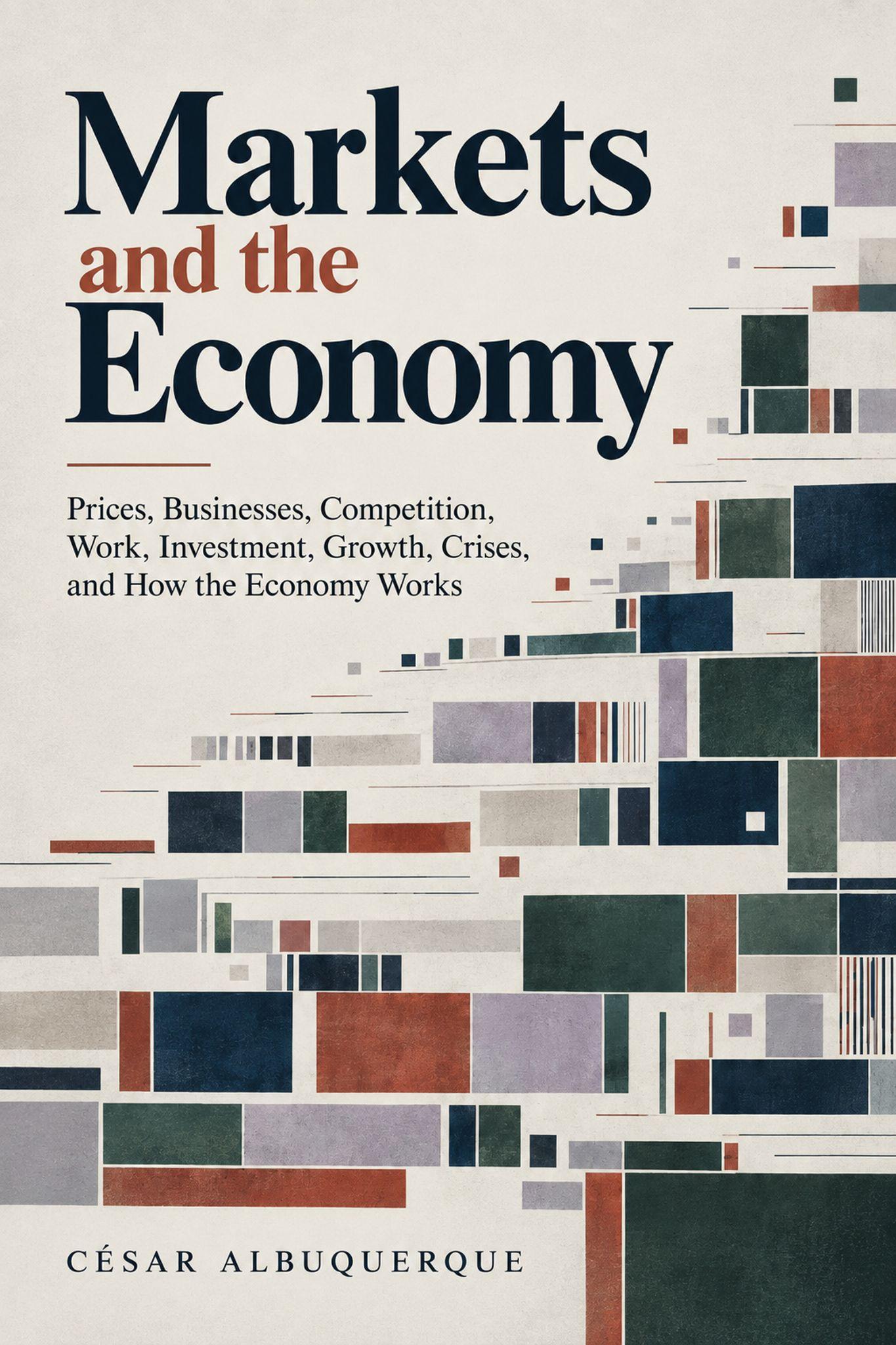
Markets and the Economy
Prices, Businesses, Competition, Work, Investment, Growth, Crises, and How the Economy Works
Millions of individual decisions influence prices, production, jobs, and investment without relying on a single central authority. This book helps you understand how markets work by showing how scarcity, incentives, supply, demand, costs, and expectations coordinate the choices of consumers, businesses, and investors.
The argument
The book examines how firms organize production, pursue productivity and profit, and compete for consumers. By analyzing competition, monopolies, oligopolies, network effects, and regulation, it explains why some markets remain competitive while others concentrate economic power. It also explores situations in which prices fail to incorporate all the costs and benefits involved in production and consumption decisions.
The analysis extends to the labor market, wages, unemployment, automation, consumption, saving, and investment. By connecting household, business, and financial decisions, the book shows how credit, risk, technology, productivity, and expectations influence economic activity and the opportunities available to individuals and firms.
The discussion concludes with economic growth, innovation, development, recessions, bubbles, business cycles, economic policy, and international trade. The result is an integrated view of how decentralized decisions are transformed into production, income, employment, investment, and structural change across the economy.
Read around the book
Continue the investigation.
How Does the Economy Work? Scarcity, Choices, Incentives, and Markets Explained
Economics begins with a simple fact: people want many things, but the resources available to satisfy those wants are limited. Time, land, labor, raw materials, machinery, knowledge, and money can all be used in different ways, yet none exists in unlimited supply.
What Is Opportunity Cost? Why Every Economic Choice Has a Hidden Cost
Every choice closes the door to another possibility. When people spend money, use time, invest capital, accept a job, launch a business project, or direct public resources toward one goal, they are not only choosing what to do.
Supply and Demand Explained: How Markets Determine Prices and Quantity
Supply and demand describe one of the most important processes in economics: how buyers and sellers interact to determine what gets produced, how much is exchanged, and at what price. The idea applies to everything from food and housing to labor, energy, smartphones, and financial assets.
How Are Prices Determined? Supply, Demand, Costs, Competition, and Expectations
Prices are among the most visible signals in an economy, yet they are often misunderstood. A price can look like a simple number attached to a product, but behind that number lies a network of decisions made by consumers, businesses, workers, suppliers, investors, and sometimes governments.
Why Prices Rise: The Economic Forces Behind Higher Prices
A rising price can look simple from the outside. A product that cost $10 now costs $12, so it is tempting to search for a single explanation.
What Is Market Power? How Companies Gain Control Over Prices and Competition
In a highly competitive market, a business has limited control over the price it charges. If it raises prices too far above its rivals, customers can simply switch.
Competition Explained: How Rivalry Between Companies Shapes Prices and Innovation
Competition is one of the main forces that disciplines markets. When several companies seek the same customers, each firm must consider what its rivals are offering.
What Is Information Asymmetry? Why Buyers and Sellers Rarely Know the Same Things
Most economic transactions involve some uncertainty. A buyer does not know everything about a product, a lender cannot perfectly predict whether a borrower will repay, and an employer cannot know exactly how productive a new worker will be.
Why Do Companies Exist? The Economics Behind Firms, Employees, and Organizations
Markets can coordinate enormous amounts of activity through prices. A buyer finds a seller, they agree on terms, and an exchange occurs.
Why Are Some Countries Rich and Others Poor? Productivity, Institutions, and Economic Development
The differences in living standards between countries are among the largest and most persistent facts in economics. Some societies can provide high incomes, reliable infrastructure, advanced healthcare, and broad access to education, while others struggle to meet basic needs.
What Drives Economic Growth? Productivity, Investment, Technology, and Human Capital
Economic growth occurs when an economy produces more goods and services over time. In the short run, production can rise because unemployed workers return to jobs or factories use previously idle capacity.
What Causes Recessions? Understanding Business Cycles and Economic Downturns
Economies do not grow at a perfectly steady pace. Periods of expanding production and employment are regularly interrupted by slowdowns or recessions.