 HERMES SOCRATICUS
Artificial intelligence
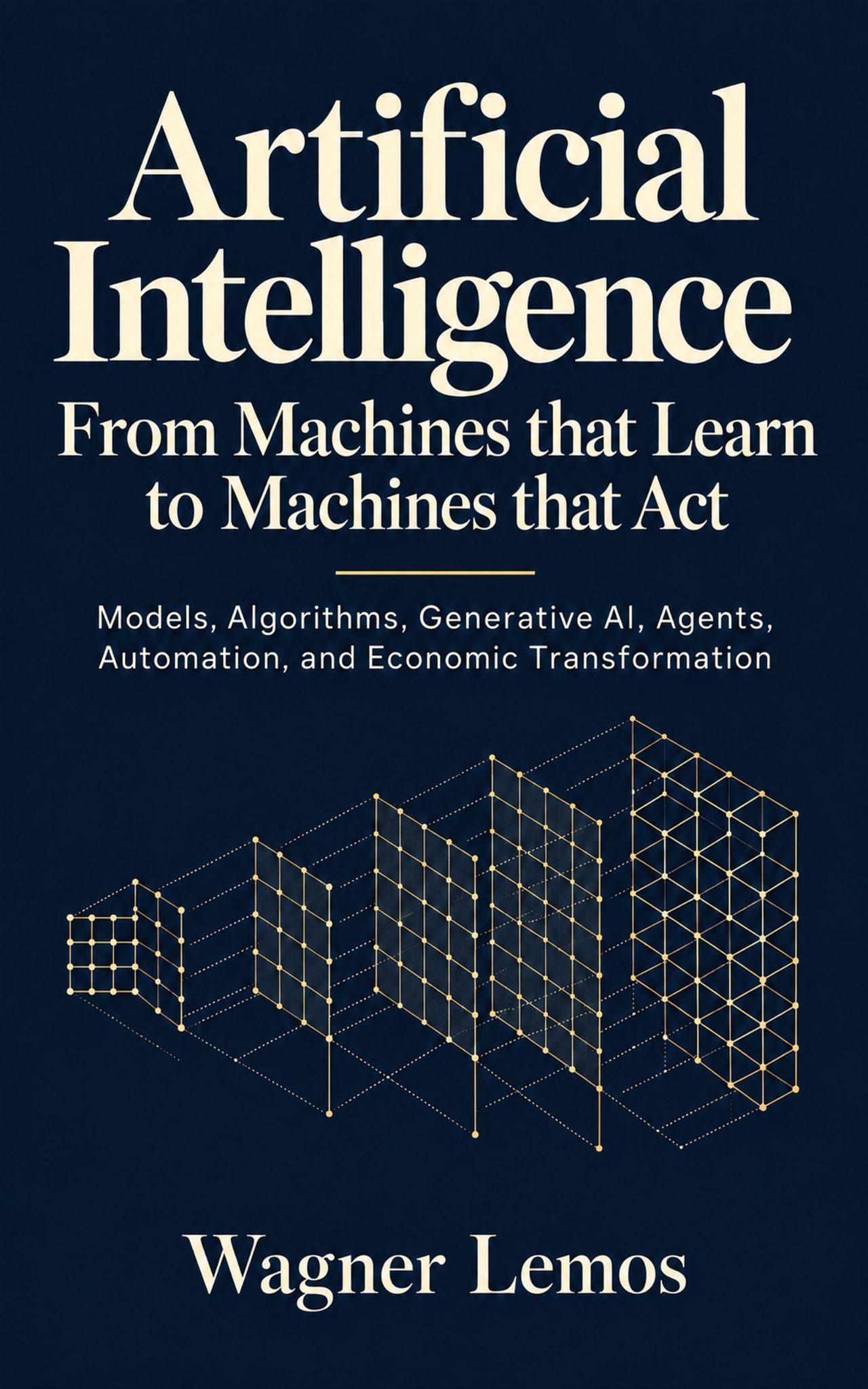
Artificial Intelligence: From Machines that Learn to Machines that Act
Models, Algorithms, Generative AI, Agents, Automation, and Economic Transformation
How does artificial intelligence learn, create content, and begin to carry out tasks? And what does that change about work, the economy, and everyday life?
The argument
Artificial Intelligence: From Machines that Learn to Machines that Act explains how AI works and what its growing capabilities mean for society, in language accessible to general readers. It begins with the fundamentals and progresses to generative AI and autonomous agents: systems that can use tools, plan steps, and perform tasks with varying levels of human supervision.
Across 64 chapters, readers explore machine learning, neural networks, and deep learning, alongside large language models and the technologies behind AI-generated text, images, audio, and video. The book also explains the role of data, chips, and data centers, revealing the resources and costs involved in building these systems.
What happens when these capabilities enter businesses, schools, hospitals, and governments? The book examines workplace automation, the future of professions, applications in science and medicine, and the economic and geopolitical competition for control of artificial intelligence. Education, culture, surveillance, disinformation, and military uses are also part of the discussion.
Limitations receive as much attention as advances. Hallucinations, bias, security failures, and problems of control explain why a convincing AI response is not always reliable-and why delegating a task requires more than getting a good answer.
For readers who want to understand artificial intelligence from its foundations to its effects on society, this book offers a broad account that requires no technical background. It provides a basis for following developments, assessing promises, and recognizing where human judgment remains essential.
Read around the book
Continue the investigation.
What Are AI Agents? How Autonomous AI Systems Work and Why They Matter
AI agents are artificial intelligence systems designed not only to produce answers but also to pursue goals through a sequence of actions.
Will AI Replace Human Jobs? Automation, Employment, and the Future of Work
The question of whether artificial intelligence will replace human jobs is more complicated than a simple choice between employment and unemployment. AI is already changing how many kinds of work are performed, but technological change usually affects specific tasks before it eliminates entire occupations.
How Does Generative AI Work? Understanding Text, Image, Audio, and Video Generation
Generative artificial intelligence is a type of AI designed to create new content rather than simply classify, sort, or retrieve existing information. It can produce text, images, music, speech, software code, and increasingly realistic video.
How Do Large Language Models Work? Tokens, Transformers, Training, and Reasoning
Large language models are artificial intelligence systems trained to recognize and generate patterns in language. They power many modern tools that can answer questions, summarize documents, write code, translate text, explain concepts, and hold extended conversations.
Why Does AI Hallucinate? Causes, Examples, and the Limits of AI Reliability
AI hallucinations occur when an artificial intelligence system generates information that sounds plausible but is false, unsupported, or invented. A model may provide a nonexistent source, misstate a historical fact, attribute a quotation to the wrong person, describe a feature that does not exist, or confidently explain an event that never happened.
What Is Artificial General Intelligence (AGI)? How It Differs From Today's AI
Artificial general intelligence, usually abbreviated as AGI, is the idea of an artificial intelligence system that can perform a wide range of intellectual tasks with a level of flexibility comparable to human beings.
AI Agents vs. Traditional Automation: What's the Difference for Businesses?
AI agents and traditional automation are both designed to reduce manual work, but they operate in fundamentally different ways. Traditional automation follows predefined rules and executes repeatable processes with high consistency.
Why Does Artificial Intelligence Need So Much Energy? AI Data Centers Explained
Artificial intelligence can feel like a purely digital technology, but modern AI depends on a large physical infrastructure of chips, servers, data centers, electrical systems, and cooling equipment. Training and operating advanced models requires enormous amounts of computation, and computation consumes energy.
What Are Multi-Agent AI Systems? How AI Agents Collaborate to Solve Complex Tasks
Multi-agent AI systems are artificial intelligence architectures in which several agents work together rather than relying on a single system to handle an entire task. Each agent may have its own role, tools, instructions, memory, or area of expertise, while a coordination mechanism determines how their work is combined.
The Economics of Artificial Intelligence: Who Will Capture the Productivity Gains?
The economics of artificial intelligence is largely about what happens when certain forms of cognitive work become cheaper, faster, and easier to scale. AI can already assist with writing, coding, analysis, design, customer support, research, forecasting, and many other knowledge-based activities.
How Is AI Changing Education? Personalized Learning, AI Tutors, and Critical Thinking
Artificial intelligence is changing education by making it easier to personalize instruction, generate explanations, provide feedback, and expand access to learning support. AI systems can help students practice at their own pace, assist teachers with routine tasks, and make educational resources more widely available.
How Is AI Transforming Scientific Research? From Drug Discovery to Automated Laboratories
Artificial intelligence is becoming an increasingly important tool in scientific research because it can analyze enormous amounts of data, detect patterns that are difficult for people to see, and help researchers explore possibilities more quickly.